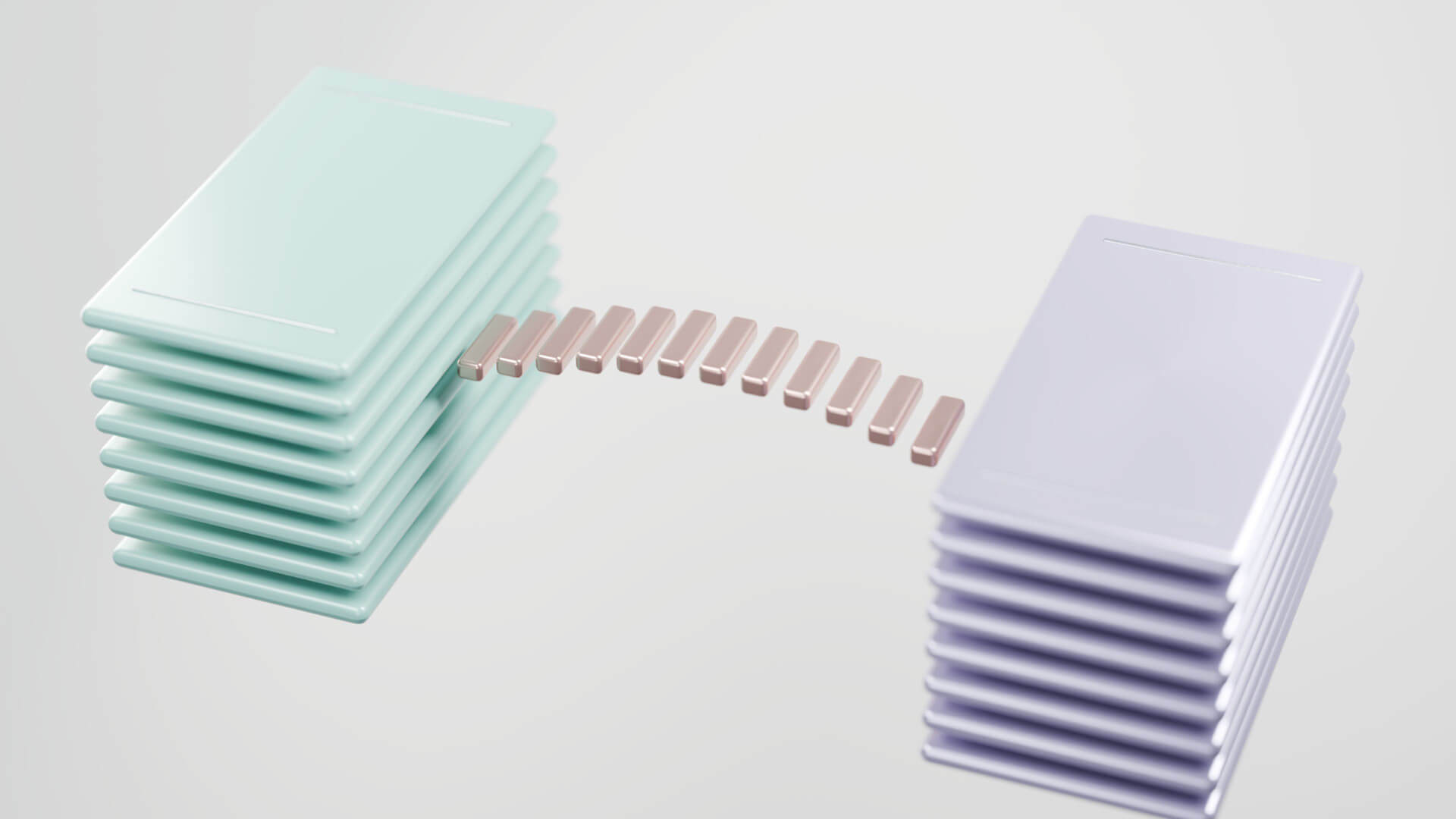
In BeeBEEP 5 two computers can talk only if one can reach the other directly. It is simple and it is private, but it has a limit that offices met all the time: two floors on separate networks, a Wi-Fi that keeps its devices apart, a laptop at home on a VPN. Laura sees Giulia, Giulia sees Paolo, and yet Laura and Paolo cannot write to each other, even though both are talking to Giulia at this very moment.
A colleague in the middle
The new BeeBEEP can use Giulia. When Laura writes to Paolo and there is no direct road, her BeeBEEP hands the message to one that can reach him, and that one passes it on. This is the relay. Direct is always preferred: the relay is only the way around, and as soon as a direct connection becomes possible, say the VPN comes up, the conversation moves onto it by itself.
A sealed envelope
Whoever carries a message cannot read it. It is encrypted from Laura's device to Paolo's, and the one in the middle sees only an envelope that says from whom and to whom. It is better to say it plainly: a relay can know that Laura is writing to Paolo, never what she writes. The keys are the ones you already know from Who is on the other end: remembered at the first meeting, with a warning if one changes.
Only if the colleague agrees
Nobody becomes a relay without knowing it. In the settings every BeeBEEP chooses: carry messages for nobody, only for contacts and members of its groups, or for everyone. On a computer the default is everyone; on a phone, which has a battery and a data plan to look after, only contacts. A BeeBEEP that will not carry a message says so at once, and the sender tries another road if there is one. There is also a limit to how much any one person can push through you, so nobody can use your computer to flood the network.
Several roads, and a safety net
If more colleagues can carry the message, BeeBEEP keeps them all and prefers the one that delivered last time. A message never goes round in circles: it has a fixed number of hops, and a copy already seen is dropped. And it is never considered delivered until the receipt from Paolo comes back; until then Laura's BeeBEEP sends it again.
A relay with no window
The relay does not have to be somebody's work computer. The new BeeBEEP also comes as
beebeep-relay, the same engine with no window, made to run all day on a small machine or a server; the
Linux package includes its service file. Put one where both networks can reach it, list it in
beehosts.ini, and every BeeBEEP that does can reach the others through it. It is still a BeeBEEP: no
accounts, no registration, it belongs to whoever runs it, and it only ever sees sealed envelopes.